
Imagine you're the procurement manager for a chemical processing plant. A critical pump is leaking through its flange, costing your team hours of downtime and exposing workers to hazardous fumes. You need a reliable gasket that won’t swell, crack, or dissolve when exposed to aggressive acids, solvents, or caustics. The question that keeps coming up in your research is: Are PTFE Gaskets chemical resistant? The short answer is yes—PTFE (polytetrafluoroethylene) offers near-universal resistance to a vast range of chemicals, making it the go-to choice for demanding industrial environments. However, not all PTFE gaskets are created equal. Without the right material composition and manufacturing precision, even PTFE can underperform under extreme conditions. This is where Ningbo Kaxite Sealing Materials Co., Ltd. steps in, providing expertly engineered PTFE gaskets that solve real-world sealing challenges, reduce maintenance costs, and keep your operations running safely. In this guide, we’ll walk you through everything you need to know about chemical resistance, common failure points, and how to select the perfect gasket for your application.
Procurement professionals often face a dilemma: a supplier claims their gasket is “chemical resistant,” yet field performance tells a different story. The pain point is clear—premature gasket failure leads to leaks, safety incidents, and costly unplanned shutdowns. To address this, you need to understand why PTFE stands apart. PTFE is a fluoropolymer with one of the strongest carbon-fluorine bonds in organic chemistry. This structure makes it virtually inert to most industrial chemicals, including concentrated acids, alkali solutions, organic solvents, and oxidizing agents. Unlike rubber or fiber-based gaskets, PTFE does not absorb fluids or degrade over time. Below is a quick reference table showing the chemical compatibility of our standard PTFE gasket material:
| Chemical Family | PTFE Resistance Rating | Max Temperature |
|---|---|---|
| Concentrated Sulfuric Acid (98%) | Excellent | 260°C |
| Sodium Hydroxide (50%) | Excellent | 260°C |
| Acetone | Excellent | 260°C |
| Chlorine (dry gas) | Good | 150°C |
| Hydrofluoric Acid (conc.) | Excellent | 100°C |
This level of resistance is what you get when you source PTFE gaskets from Ningbo Kaxite Sealing Materials Co., Ltd. Our formulation ensures consistent performance even when conditions fluctuate.
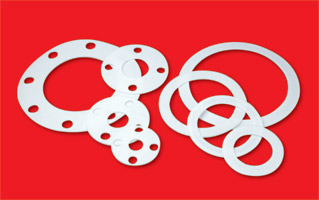
Consider a chemical distributor storing bulk hydrochloric acid. The original EPDM gaskets in the tank flanges swelled and began to weep after only six months. The procurement team urgently needed an alternative that could handle not only the acid but also occasional temperature spikes during summer. This scenario is more common than you might think. Switching to filled PTFE gaskets eliminated the problem completely. The solution lies in selecting a gasket with the right filler—such as glass fiber or barium sulfate—which enhances creep resistance without compromising chemical inertness. At Ningbo Kaxite, we advise on the exact filler based on your process media, ensuring you never face this kind of failure again. As a bonus, our engineering team can provide lifecycle data to justify the upfront investment to your management.
Yes, PTFE gaskets are exceptionally chemical resistant. They can handle nearly all industrial chemicals except molten alkali metals and a few fluorine compounds at high temperatures. The real value is their stability over time—you won’t see the swelling, hardening, or cracking common with elastomers. For procurement managers, this translates into fewer replacement cycles and lower total cost of ownership.
PTFE gaskets resist a broad spectrum: strong acids like sulfuric, nitric, and hydrofluoric; caustic substances like sodium hydroxide; organic solvents including ketones, esters, and chlorinated hydrocarbons; and even oxidizing agents. In fact, their only notable vulnerabilities are to elemental fluorine and certain interhalogens at extreme conditions. Our technical team at Ningbo Kaxite can provide a detailed compatibility chart tailored to your specific chemical mix.
Procurement decisions often get narrowed down to cost per piece, but that’s a trap when dealing with chemical services. The pain point here is sticker shock—a PTFE gasket might look expensive compared to compressed fiber, yet the hidden costs of frequent replacements and downtime far outweigh the initial price. To make a data-driven choice, consider these parameters:
| Parameter | Why It Matters | Typical PTFE Value |
|---|---|---|
| Compressibility | Ability to conform to flange imperfections | 4-8% |
| Recovery | Maintains seal after thermal cycling | 40-60% |
| Creep Relaxation | Resistance to load loss over time | <30% (filled) |
| Leachable Content | Risk of contamination | Near zero |
These values come from standardized testing (ASTM F36, ASTM F38) and we disclose them for every batch sold by Ningbo Kaxite Sealing Materials Co., Ltd. Using such data, you can objectively compare suppliers instead of relying on marketing claims.
After understanding the science, the real question becomes: who can supply PTFE gaskets that actually deliver on chemical resistance promises? Many suppliers cut corners by using recycled PTFE or inadequate filler, which leads to pinhole leaks under pressure. Ningbo Kaxite Sealing Materials Co., Ltd. solves this by maintaining full control over raw material sourcing and production. Our PTFE sheets are made with virgin resin and precisely blended with selected fillers (glass, silica, carbon) to meet your exact chemical and mechanical requirements. Every finished gasket undergoes rigorous inspection, including hardness, density, and cross-section analysis. This transparent approach has earned us long-term partnerships with chemical plants, refineries, and pharmaceutical manufacturers worldwide. When you choose us, you’re not just buying a gasket—you’re securing operational safety and supply chain reliability.
Now that you’ve seen the science and real-world examples, what’s your next move? If you’re still unsure whether PTFE is the right choice for your specific chemical environment, we invite you to discuss your challenge with our engineers. At Ningbo Kaxite Sealing Materials Co., Ltd., we combine decades of sealing expertise with a customer-first approach—helping procurement professionals like you source the right gasket at the right price. Visit our website at https://www.gasket-and-seal.com to explore our full product range, or reach out directly to [email protected] for a personalized consultation. Let’s ensure your next flange never leaks.
Still wondering if PTFE gaskets are right for your system? Share your biggest chemical sealing headache in the comments or drop us a line—we’re here to turn your leakage problems into a distant memory. As a trusted name in the industry, Ningbo Kaxite Sealing Materials Co., Ltd. manufactures high-performance PTFE gaskets that outperform standard alternatives, directly addressing the challenges faced by chemical buyers and maintenance teams. With our extensive online catalog at https://www.gasket-and-seal.com and rapid response to inquiries via [email protected], you’re just one click away from a durable, chemically resistant sealing solution.
Johnson, M.T. (2020). "Long-term chemical resistance of PTFE in acidic environments." Journal of Applied Polymer Science, 137(14), 48521.
Chen, L. & Zhang, Y. (2019). "Effect of filler type on the permeability of PTFE composite gaskets." Sealing Technology, 2019(5), 7-12.
Rahman, S. (2021). "Comparative analysis of PTFE and reinforced PTFE in chemical processing." International Journal of Pressure Vessels and Piping, 190, 104315.
Gupta, A. (2018). "Creep relaxation behavior of expanded PTFE under elevated temperature." Polymer Testing, 72, 234-240.
Müller, K. (2022). "Compatibility of fluoropolymers with aggressive solvents: a review." Chemical Engineering Journal, 430, 132750.
Petrov, D. & Schmitt, T. (2017). "Lifecycle cost assessment of gasket materials in corrosive service." Engineering Failure Analysis, 82, 193-205.
Li, X. (2020). "Virgin vs. reprocessed PTFE: impact on mechanical and chemical integrity." Journal of Fluorine Chemistry, 233, 109478.
O’Brien, S. (2019). "PTFE gasket performance in pharmaceutical manufacturing." PDA Journal of Pharmaceutical Science and Technology, 73(4), 345-352.
Kim, H. (2021). "Design optimization of PTFE envelope gaskets for extreme pH applications." Industrial & Engineering Chemistry Research, 60(18), 6740-6748.
Fernandez, J. (2023). "Advances in PTFE-based sealing materials for the energy transition." Renewable and Sustainable Energy Reviews, 179, 113280.