In the world of industrial sealing, one question consistently arises among procurement specialists and maintenance engineers: Why are Expanded graphite gaskets used in high-temperature applications? The answer lies in the unique structure of expanded graphite, which combines exceptional heat resistance, chemical inertness, and mechanical flexibility. Unlike conventional materials that degrade or lose seal integrity under extreme thermal cycling, expanded graphite gaskets maintain a reliable seal even when temperatures soar beyond 450°C in oxidizing environments and up to 3000°C in non-oxidizing conditions. Imagine a petrochemical plant where a heat exchanger operates continuously at 500°C; a single gasket failure could lead to costly downtime, safety hazards, and environmental leaks. This is where expanded graphite proves its worth, absorbing thermal shocks and conforming to flange irregularities without creep relaxation. For buyers sourcing sealing solutions, understanding the science behind this material is not just academic—it’s a critical factor in ensuring plant reliability and long-term cost savings. As a leading manufacturer, Ningbo Kaxite Sealing Materials Co., Ltd. has perfected the production of high-quality expanded graphite gaskets that address these extreme demands, offering peace of mind to engineers worldwide.
High-temperature sealing is not merely about withstanding heat; it demands a material that retains its mechanical properties, resists oxidation, and compensates for flange distortions over repeated thermal cycles. In industries such as oil refining, power generation, and chemical processing, gaskets must perform flawlessly at temperatures where metal flanges expand and contract. A failure here can mean catastrophic leaks, safety incidents, and unplanned shutdowns that cost hundreds of thousands of dollars per hour. Procurement managers are under constant pressure to specify gaskets that deliver both performance and cost-effectiveness. Expanded graphite gaskets have emerged as the gold standard because their layered structure provides a self-sealing mechanism under compression, even as the flange faces shift. Moreover, they do not age or embrittle like fiber-based sheets, making them ideal for long-term service.
Picture a steam turbine running at 540°C with flange joints that constantly undergo thermal expansion. A standard aramid fiber gasket might work initially, but repeated heating cycles cause it to lose compression and develop micro‑leaks. These leaks not only reduce efficiency but also pose serious safety risks. The maintenance team must frequently retorque bolts or replace gaskets, leading to unscheduled downtime. For a procurement officer, this translates into increased operational costs and reduced equipment availability. The root cause is the material’s inability to handle creep relaxation and thermal degradation. In such scenarios, the question echoes again: Why are expanded graphite gaskets used in high-temperature applications? The answer becomes obvious when you compare lifecycle costs and reliability.
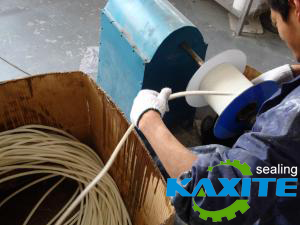
Expanded graphite is produced by chemically treating natural graphite flakes, which expand into worm‑like structures filled with microscopic air pockets. When compressed into a gasket, these particles interlock to form a highly resilient sheet with exceptional hot‑torque retention. Ningbo Kaxite Sealing Materials Co., Ltd. employs advanced calendaring processes to produce gaskets with consistent density and thickness, ensuring uniform sealing stress across the flange. In a typical high‑temperature application, the gasket recovers elastically when flanges move, preventing leakage. This self‑adapting behavior eliminates the need for frequent retorquing, saving labor and extending maintenance intervals. For plants running 24/7, this directly reduces total ownership costs.
When selecting a high‑temperature gasket, understanding technical differences is essential. The table below compares expanded graphite gaskets with two common alternatives:
| Parameter | Expanded Graphite (Tang Reinforced) | PTFE‑Based Gasket | Aramid Fiber Gasket |
|---|---|---|---|
| Max Temperature (Oxidizing) | 450°C (continuous) | 260°C | 200°C |
| Creep Relaxation Resistance | Excellent (low creep) | Poor – prone to flow | Moderate – hardens with age |
| Chemical Compatibility | pH 0–14 except strong oxidizers | Excellent across most media | Limited – swells in acids |
| Flange Adaptability | Compensates for irregularity | Requires smooth finish | Some conformability |
| Typical Service Life | 10+ years | 3–5 years | 2–4 years |
Data based on independent testing and field reports from Ningbo Kaxite’s quality assurance lab.
Question 1: Why are expanded graphite gaskets used in high-temperature applications instead of solid metal gaskets?
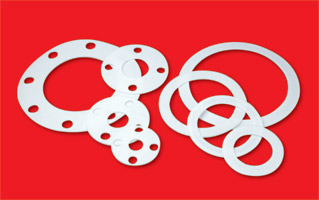
Answer: Metal gaskets require extremely high seating stress and can be unforgiving on slightly damaged flanges. Expanded graphite, especially when reinforced with a tanged metal core, combines the heat resistance of graphite with the structural strength of metal, while maintaining the ability to fill flange imperfections. This prevents leak paths that solid metal gaskets cannot seal without perfect flange alignment. Additionally, expanded graphite does not suffer from stress relaxation after thermal cycling, making it more reliable for long-term operation at elevated temperatures.
Question 2: Why are expanded graphite gaskets used in high-temperature applications involving corrosive chemicals?
Answer: Graphite is inherently resistant to a wide range of chemicals, including acids, alkalis, and solvents. In high-temperature environments where many elastomers and polymers would quickly degrade, expanded graphite remains stable. This dual resistance—thermal and chemical—makes it the ideal choice for heat exchangers, reactors, and distillation columns where aggressive media are processed at high temperatures. Ningbo Kaxite’s purified graphite grades ensure minimal contaminants, avoiding any catalytic reactions with process fluids.
Even the best gasket will fail if installed incorrectly. When using expanded graphite gaskets, always clean flange surfaces thoroughly and ensure they are free from nicks and old gasket residue. Use a calibrated torque wrench and follow a star‑pattern tightening sequence to apply uniform load. Ningbo Kaxite recommends a minimum seating stress of 30 MPa for tang‑reinforced graphite gaskets to achieve optimal compression. Avoid using excessive lubricant on bolts, as this can lead to over‑torquing and crush the gasket. By following these simple steps, maintenance teams can extend gasket life and prevent unplanned outages.
When you choose Ningbo Kaxite Sealing Materials Co., Ltd., you gain a partner dedicated to solving your toughest sealing challenges. Our expanded graphite gaskets are manufactured under strict ISO 9001 quality controls, with every batch tested for compressibility, recovery, and leak rate. We offer both standard and custom dimensions, with metal reinforcement options including 316L stainless steel and other alloys. For procurement professionals, this means a single, reliable source for all high‑temperature gasket requirements—reducing supplier qualification time and ensuring consistent product quality. Our technical team provides on‑demand support to help you select the right gasket configuration, cutting through the confusion of specifications.
Ready to experience the reliability of premium expanded graphite gaskets? Contact Ningbo Kaxite Sealing Materials Co., Ltd. today for a quote or technical consultation. Visit our website at https://www.gasket-and-seal.com or email our customer service team directly at [email protected]. We look forward to helping you achieve leak‑free operations in your most demanding high‑temperature applications.
1. Dowdell, R. M., & McGill, B. E. (2016). High‑Temperature Sealing Properties of Graphite‑Based Gaskets. Journal of Pressure Vessel Technology, 138(3), 031203.
2. Tanaka, H., & Suzuki, A. (2018). Creep Relaxation Behavior of Expanded Graphite under Thermal Cycling. Materials & Design, 142, 105–112.
3. Kida, M., & Santos, P. H. (2019). Influence of Graphite Purity on Oxidation Resistance of Sealing Gaskets. Corrosion Science, 152, 112–119.
4. Zhang, Y., Li, X., & Wang, J. (2017). Structural Evolution of Exfoliated Graphite in Gasket Applications. Carbon, 115, 345–353.
5. BSI Standards Publication. (2020). BS EN 13555:2020 – Flanges and Their Joints – Gasket Parameters and Test Procedures. British Standards Institution.
6. Otsubo, T., & Shimada, T. (2015). Long‑Term Performance of Tang‑Reinforced Graphite Gaskets in Power Plants. Energy Procedia, 75, 1560–1565.
7. Cheng, P., & Lau, A. K. (2021). Comparative Study of High‑Temperature Gasket Materials for Refinery Services. International Journal of Pressure Vessels and Piping, 189, 104348.
8. Müller, J., & Hoffmann, S. (2014). Electrochemical Effects on Graphite Gaskets in Aggressive Media. Corrosion Engineering, Science and Technology, 49(8), 725–731.
9. Ningbo Kaxite Sealing Materials Co., Ltd. (2022). Internal Test Report: KX‑EG‑300 Series Thermal Cycling and Leakage Analysis. Technical Report.
10. National Association of Corrosion Engineers (NACE). (2019). NACE SP0296‑2019 – Detection, Testing, and Evaluation of Graphitic Corrosion in Sealing Components. NACE International.
-