Picture this: Your production team receives a batch of PTFE Rods for machining valve seats, gaskets, or insulators. The material looks easy to handle, but the first saw cut leaves a furry, torn edge. A lathe pass produces a tapered, out-of-tolerance part. The rod softens, deforms, or even melts locally under tool pressure. Scrap rates climb, delivery schedules slip, and purchasing gets blamed for choosing the wrong material. This raises a critical question for engineers and procurement professionals alike: How do you cut or machine PTFE rods without damaging them? The answer is not simply buying a sharper blade. It requires the right tool geometry, controlled speeds, workholding that avoids crushing, and starting with stress-relieved PTFE rod stock. In this guide, you will find practical, shop-floor-ready methods used by sealing component manufacturers and maintenance teams. Ningbo Kaxite Sealing Materials Co., Ltd. also shares how proper rod selection reduces machining waste and improves finished part quality.
Contents
PTFE rods have low thermal conductivity, a high coefficient of thermal expansion, and relatively low compressive strength. A machinist may treat the material like nylon or acetal, but the rod deflects, expands from heat, and tears at the cut surface. The result is uneven sealing faces, non-round diameters, and poor surface finish. These problems often appear only after the first operation, when the workpiece has already consumed machine time and tooling cost.
The solution starts with recognizing that PTFE rods are not rigid like metal. Use sharp tools, low cutting forces, and stress-relieved rod stock. Ningbo Kaxite Sealing Materials Co., Ltd. supplies PTFE rods with controlled density and low internal stress to reduce movement during machining. When the blank is stable, the operator can focus on proper cutting technique instead of compensating for material defects.
| Damage Type | Common Cause | Shop-Floor Symptom | Prevention |
|---|---|---|---|
| Torn or furry edge | Dull saw blade or wrong tooth pitch | Rough cut face, fibrous strings | Use fine-tooth blade and sharp edge |
| Out-of-round diameter | Excessive clamping force | Lobed or oval cross-section | Use soft jaws and uniform support |
| Surface melting | High cutting speed, no coolant | Glazed or discolored surface | Reduce speed, use air coolant |
| Tapered part | Tool pressure and heat expansion | Diameter differs from end to end | Rough then finish with light passes |
Many shops use standard steel-cutting inserts on PTFE rods. The tool geometry creates high cutting forces and heat. Because PTFE does not dissipate heat well, local temperatures rise and the rod swells during the cut. When it cools, the dimension shrinks and the part falls out of tolerance. Procurement teams then face returns, rework, or field failures that could have been avoided at the machining stage.
The solution is to use high-speed steel or polished carbide tools with sharp edges, high positive rake angles, and generous clearance. Low spindle speeds and moderate feed rates keep heat low. Dry compressed air or mist coolant can remove heat without contaminating the surface. This approach keeps the rod dimensionally stable and the surface clean enough for sealing applications.
| Parameter | Recommended Setting | Effect |
|---|---|---|
| Tool material | Sharp HSS or polished carbide | Low cutting force, clean shear |
| Rake angle | 10° to 15° positive | Reduces rubbing and heat |
| Clearance angle | 7° to 12° | Prevents dragging on the rod surface |
| Cutting speed | 100–250 m/min for turning | Balances productivity and heat |
| Feed rate | 0.05–0.15 mm/rev | Controls surface finish |
| Coolant | Dry air or mist coolant | Avoids thermal shock, keeps swarf clear |
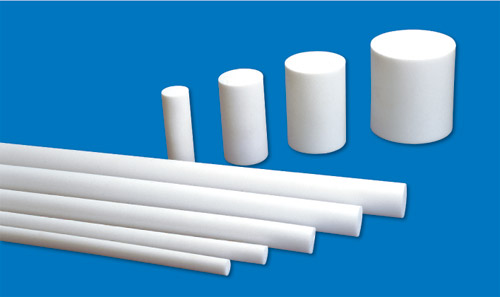
Even with the right tool, a poorly planned sequence can still produce rejects. A deep roughing pass or uneven feed can deflect the rod, causing chatter marks and dimensional drift. For longer or thinner PTFE rods, the problem becomes worse because the material lacks the stiffness to resist cutting forces.
The solution is to follow a staged process. Support the rod in a sleeve or collet when possible. Take light roughing passes, allow the part to cool briefly, then take a final finishing pass with fine feed. This is especially important when the final component will be used as a sealing face or a bearing surface where flatness and roundness are critical.
| Operation | Recommended Practice | Result |
|---|---|---|
| Sawing | Fine-tooth blade, low feed, rod supported close to cut | Square, low-burr cut end |
| Turning roughing | 0.5–1.0 mm depth of cut | Removes material with low deflection |
| Turning finishing | 0.05–0.20 mm depth of cut | Tight tolerance and smooth finish |
| Drilling | Sharp drill, low thrust, peck cycles | Round holes without melting |
| Milling | Climb milling, low radial engagement | Clean edges, less burr |
A purchasing team may ask whether to cut PTFE rods in-house or source pre-machined blanks. Different methods carry different risks. The right choice depends on rod diameter, tolerance, batch size, and the final sealing requirement. Choosing the wrong method can generate hidden costs through high scrap rates or inconsistent part quality.
The solution is to compare common methods before production. For prototypes and small batches, sawing and turning are usually enough. For complex profiles, CNC milling with sharp tooling works well. For very soft or thin rods, waterjet cutting can avoid mechanical stress, but edge quality must be verified. Starting with dimensionally stable PTFE rods from Ningbo Kaxite Sealing Materials Co., Ltd. makes each method easier to control.
| Method | Best For | Risk | Result |
|---|---|---|---|
| Band saw | Rough cutting to length | Burrs, wavy cut | Acceptable with fine blade and support |
| CNC turning | Rings, discs, valve seats | Heat expansion, taper | Excellent with light finish pass |
| CNC milling | Slots, profiles, sealing faces | Burr and fuzz | Good with sharp tools and climb milling |
| Waterjet | Thin or delicate profiles | Edge roughness if parameters wrong | Low stress, moderate edge finish |
Use a fine-tooth band saw blade for cutting to length, keep the rod supported close to the cut, and feed slowly. For turning, choose sharp high-speed steel tools with positive rake angles and take light finishing passes. Low spindle speeds, dry air cooling, and soft jaws help prevent deformation. Selecting stress-relieved PTFE rods from a reliable supplier also makes a noticeable difference in cut quality.
Polished carbide or sharp high-speed steel tools with high positive rake angles and large clearance angles work best for PTFE rods. Dull tools generate friction heat, which causes melting and dimensional drift. For drilling, use sharp drills with low thrust and peck cycles. Ningbo Kaxite Sealing Materials Co., Ltd. can recommend tooling and machining parameters based on the specific PTFE rod grade and diameter you purchase.
Procurement teams often receive PTFE rods with inconsistent diameter, internal voids, or high residual stress. These material defects show up only after cutting begins, causing unexpected scrap and production delays. When the rod is not uniform, even the best machining setup cannot produce consistent parts.
Ningbo Kaxite Sealing Materials Co., Ltd. addresses this problem through controlled manufacturing. The company supplies machinable PTFE rods made from carefully selected resin. Rods are produced with consistent density, smooth surfaces, and tight diameter tolerances to reduce machining stock and improve cutting stability. Custom diameters and lengths help you start with a blank that matches the final part, saving time and reducing waste.
| Property | Typical Value | Machining Benefit |
|---|---|---|
| Diameter tolerance | +0.5 / -0 mm or custom | Less stock removal, less heat |
| Density | 2.10–2.20 g/cm³ | Consistent cutting behavior |
| Tensile strength | ≥15 MPa | Resists tearing during cut |
| Elongation at break | ≥150% | Ductile chips, lower fracture risk |
| Working temperature | -180°C to +260°C | Stable in machining heat range |
Have you struggled with PTFE rod cutting or machining tolerances? Share your current rod diameter, tolerance requirement, and cutting method with your supplier. A well-chosen rod blank reduces tool wear, scrap, and rework from the first cut.
For buyers and engineers seeking reliable PTFE rods with consistent density and low internal stress, Ningbo Kaxite Sealing Materials Co., Ltd. provides machinable PTFE rod stock in a wide range of diameters and lengths. The team supports material selection, custom sizing, and technical guidance to help you avoid cutting damage in your production process. Contact [email protected] for product specifications, samples, or machining recommendations.
Blanchet, T. A., & Kennedy, F. E. (1992). Sliding wear behavior of polytetrafluoroethylene. Wear, 153(1), 229-243.
Biswas, S. K., & Vijayan, K. (1992). Friction and wear of PTFE—a review. Wear, 158(1-2), 193-211.
Rae, P. J., & Dattelbaum, D. M. (2004). The properties of poly(tetrafluoroethylene) (PTFE) in compression. Polymer, 45(22), 7615-7625.
Brown, E. N., & Rae, P. J. (2006). The influence of temperature and strain rate on the tensile properties of PTFE. Polymer, 47(22), 7506-7518.
Khedkar, J., Negulescu, I., & Meletis, E. I. (2002). Sliding wear behavior of PTFE composites. Wear, 252(5-6), 361-369.
Unal, H., Mimaroglu, A., & Kadıoglu, U. (2004). Sliding friction and wear behaviour of polytetrafluoroethylene and its composites under dry conditions. Materials & Design, 25(3), 239-245.
Zhang, Z., & Aglan, H. (2004). Friction and wear behavior of PTFE composites filled with ceramic particles. Journal of Materials Science, 39(2), 477-483.
Sawyer, W. G., Freudenberg, K. D., Bhimaraj, P., & Schadler, L. S. (2003). A study on the friction and wear behavior of PTFE filled with alumina nanoparticles. Wear, 254(5-6), 573-580.
Thomas, P. S. (1998). The use of fluoropolymers in the chemical process industry. Chemical Engineering Journal, 70(3), 187-196.
Ebnesajjad, S. (2015). Fluoroplastics, Volume 1: Non-Melt Processible Fluoropolymers. William Andrew Publishing, 1, 1-15.