Chemical Water & Gas Filtration
Filtration of process water, reagent water and reactive gases in chemical plants where ordinary filter materials would degrade or leach. PTFE stays inert even with strong acids, bases and oxidizers.


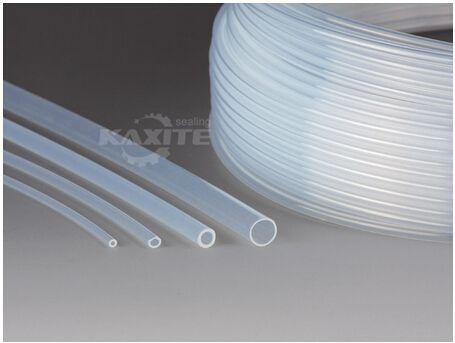
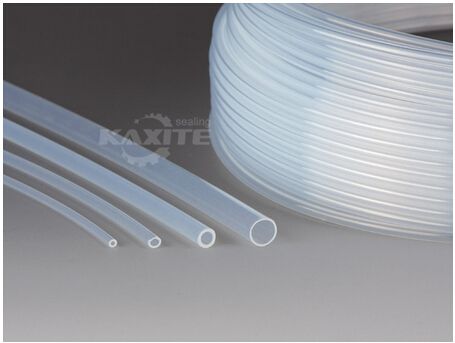
Kaxite PTFE Micro Porous Filtration Tube is produced from PTFE fine powder through a special elasticity process that forms homogeneous micropores across the tube wall. The result is a chemically inert, high-purity filter element that can filter both water and gas while withstanding nearly all industrial chemicals, solvents and corrosive liquids. Pore size is adjustable from 0.2 μm to 100 μm, and the tube performs reliably from -80°C to +250°C.
PTFE micro porous filtration tube starts as PTFE fine powder. Through a special elasticity process, the PTFE resin is stretched so the fibrils open into a homogeneous pore network across the tube wall. The tube is then sintered to lock the pore structure in place, which is why the pore size distribution stays uniform along the length of the tube and does not drift after exposure to heat or chemicals.
Because there is no binder, no adhesive and no membrane laminate, the tube remains pure PTFE. That is what gives the filter element its combination of chemical inertness, high temperature stability and low extractable content. Buyers who need the same base resin in other forms can review the full range of PTFE Tubes and PTFE & PEEK Seals.
Pore size determines which particles are retained and which pass through. Standard pore size range is 0.2 to 100 μm. For final clarification of fine chemicals and pharmaceutical liquids, 0.2-1 μm is common. For gas filtration and general chemical filtration, 1-10 μm is common. For pre-filtration and high-flow processes, 10-100 μm is used.
Porosity 60-80% decides the flow. Higher porosity gives more open flow paths and lower pressure drop, but coarser retention. Lower porosity gives finer retention but higher pressure drop. Send the target particle size and the flow rate, and Kaxite can size the pore and porosity for you.
Filtration of process water, reagent water and reactive gases in chemical plants where ordinary filter materials would degrade or leach. PTFE stays inert even with strong acids, bases and oxidizers.
Final clarification and sterile filtration of pharmaceutical liquids and solvents. PTFE is inert, non-shedding and has low extractables, so it will not contaminate the batch.
Filtration of corrosive liquids such as acids, alkalis and aggressive solvents where the filter element must survive the media rather than be consumed by it.
High-purity filtration in laboratory and semiconductor process lines where metal ion contamination and particle shedding must be kept at ultra-low levels.
Resists nearly all industrial chemicals, solvents, acids and bases, so the filter element outlives the media it is cleaning.
Stable from -80 to +250°C. No binder, no adhesive, no membrane delamination at high temperature.
Micropores formed by fibrillation across the wall, not coated on the surface, so the pore size does not drift along the tube.
Pure PTFE with no plasticizers, binders or stabilizers, which matters for pharmaceutical and semiconductor purity requirements.
The same tube can handle aqueous media, gases and mixed streams without changing materials or re-validating the filter.
Outer diameter, wall thickness, length, pore size and end connections all customizable. OEM and private label packaging supported.
Send operating medium (water / gas / chemical / solvent), flow rate, target particle size or pore size, tube outer diameter and length, quantity and destination port.
Kaxite engineers review the media and target particle size, then recommend a pore size and porosity combination that balances retention and flow.
PTFE fine powder is extruded into a tube preform, then stretched under controlled temperature to form the fibril network that becomes the micropore structure.
The tube is sintered to lock the pore structure in place. Sintering also removes residual lubricant from the extrusion step.
Pore size is verified by bubble point or equivalent test. Flow rate per unit area is recorded on the inspection sheet.
Tubes are cut to ordered length, end faces are finished, and the order is packed in clean packaging with the batch record and inspection sheet.

Pore size, porosity, tensile strength and dimension are recorded per production batch.
Bubble point or equivalent pore size test data is provided on request for pharmaceutical and semiconductor qualification.
PTFE raw material data sheet with temperature limits, chemical resistance and extractable content is provided with each shipment.
Tubes are packed in clean inner packaging to keep the pore structure free of dust during shipping and storage.
PTFE Micro Porous Filtration Tube is a tube-shaped filter element made from PTFE fine powder through a special elasticity process. The process forms homogeneous micropores across the tube wall, so the tube can filter water and gas while remaining chemically inert and resistant to nearly all industrial chemicals and solvents.
Standard pore size range is 0.2 to 100 μm. Pore size is selected based on the target particle size to be removed, the operating medium, and the required flow rate. Kaxite can produce tubes at a specified pore size within this range.
Standard porosity is 60-80%. Higher porosity gives more open flow paths and lower pressure drop, but may reduce particle retention efficiency. Lower porosity gives finer retention but higher pressure drop. Kaxite can adjust porosity based on the target filtration performance.
The recommended service temperature range is -80 to +250°C. The tube remains dimensionally stable and chemically inert across this range, making it suitable for both low-temperature and hot chemical filtration.
PTFE is chemically inert and resistant to nearly all industrial chemicals, including strong acids, strong bases, oxidizers, solvents and corrosive liquids. It is not recommended for molten alkali metals, elemental fluorine, or chlorine trifluoride at elevated temperature.
Typical applications include chemical water and gas filtration, pharmaceutical industry filtration, and corrosive liquid filtration. Also used in semiconductor, laboratory, food and beverage processing where chemical inertness and high purity are required.
Yes. Kaxite supports custom outer diameter, wall thickness, length, pore size and end connections. OEM and private label packaging are also available. Send a drawing or sample for a quotation.
Send your operating medium (water, gas, chemical or solvent), flow rate requirement, target particle size or pore size, tube outer diameter and length, quantity and destination port. Kaxite will reply with an FOB Ningbo quotation, lead time and packing details.
Send your operating medium, flow rate, target pore size, tube dimensions and quantity. Kaxite will recommend a pore size and porosity combination, then prepare an FOB Ningbo quotation with lead time and packing details.
Request Quotation NowAddress
No 432 Zhenhai Middle Road, Luotuo Street, Zhenhai District, Ningbo City, Zhejiang China